
 Wendy Elkis Class of 1977
Part 1 of New York, The American Revolution, ended in the year 1771, but let's go back a few years to understand the events that led to the New York Tea Party.
The Townshend Acts
Parliament enacted the Townshend Acts in 1767, which taxed glass, lead, paint, paper, and tea to help pay for governing the colonies. Due to these taxes, the colonists tried to discourage the purchase of British goods. During 1768-1769, colonists began to speak out against Parliament and the taxation of the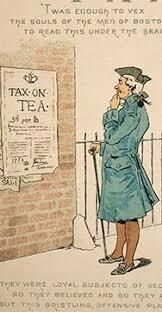 Townshend Act Notice colonies. Massachusetts called for a unified resistance of the colonies. The Virginia legislature was dissolved by the Royal Governor after the passage of the Virginia Resolves, which stated that Parliament did not have the right to tax Virginians.
In 1770, the repeal of the Townshend Acts was brought about, except for the Tea Tax. As a result, colonists began to relax their boycott of English goods. In New York, a riot erupted between citizens and British soldiers because of the NY assembly's noncompliance with 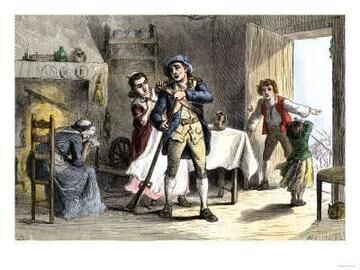 Quartering ActThe Quartering Act of 1765. On March 5, citizens of Boston surrounded British soldiers and were fired upon. Five men died in what is now called the Boston Massacre.
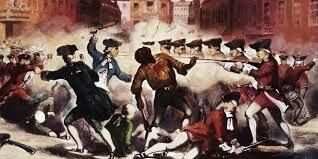 Boston Massacre
Committees of Correspondence
When Parliament reestablished parts of the Townshend Acts in 1772, which were taxes placed on goods imported into America, Samuel Adams called for Committees of Correspondence to write and inform the other colonies about Boston’s position. Part of the Townshend Acts required the Crown to pay judges' salaries. By doing so, judges were not dependent on the local area but on the Crown.
“Adams used a town meeting to enact his “Committee" explaining its role as:
“to state the rights of the colonists and of this province in particular, as men, as Christians, and as subjects: to communicate and publish the same to the several towns in this province and to the world. Prepare a letter to be sent to all the towns of this province and to the world, giving the sense of this town.” (https://www.battlefields.org/learn/articles/committees-correspondence)
Typically, towns would hold town meetings to resolve problems. Once Parliament began imposing taxes on the colonists, places like New York and Boston set up committees to address the acts Parliament imposed on them. The committees were usually headed by clergy, elders in the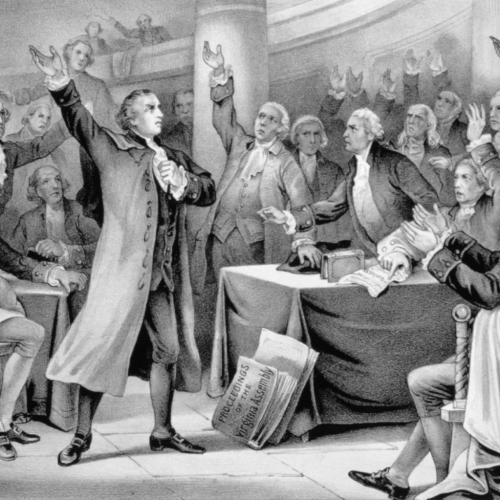 Meeting of the Committees of Correspondence 1772 community, and successful businessmen. The committees were to disband after the act was rescinded, but that didn’t happen since Parliament kept passing act after act.
By 1773, the East India Company had a monopoly on tea through the Tea Act. Not only did the Tea Act grant the East India 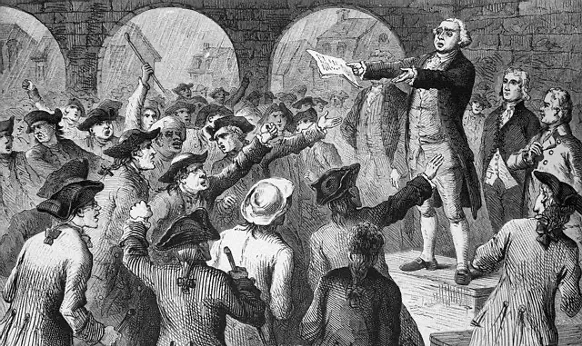 John Lamb reading the Tea ActCompany a monopoly on tea, but also other merchandise, such as fabrics, spices, drugs, etc. It granted the company power over the supply and prices of goods shipped to the colonies. This act was the one that “Broke the Camel’s Back”.
The Boston and New York Tea Parties
One day before the Boston Tea Party, on December 15, 1773, 200 merchants, lawyers, and other businessmen signed a petition in New York opposing the importation of tea. “The petition boldly proclaimed "execution of that Act, involves our slavery, and would sap the foundation of our freedom, whereby we should become slaves to our brethren...born to no greater stock of freedom than the Americans-the merchants and inhabitants of this city, in conjunction with the merchants and inhabitants of the ancient American colonies, entered into an agreement to decline a part of their commerce with Great Britain, until the above-mentioned Act should be totally repealed.”
On December 16, 1773, the Boston Tea Party occurred. 342 chests of tea were thrown overboard into Boston Harbor from a ship belonging to the British 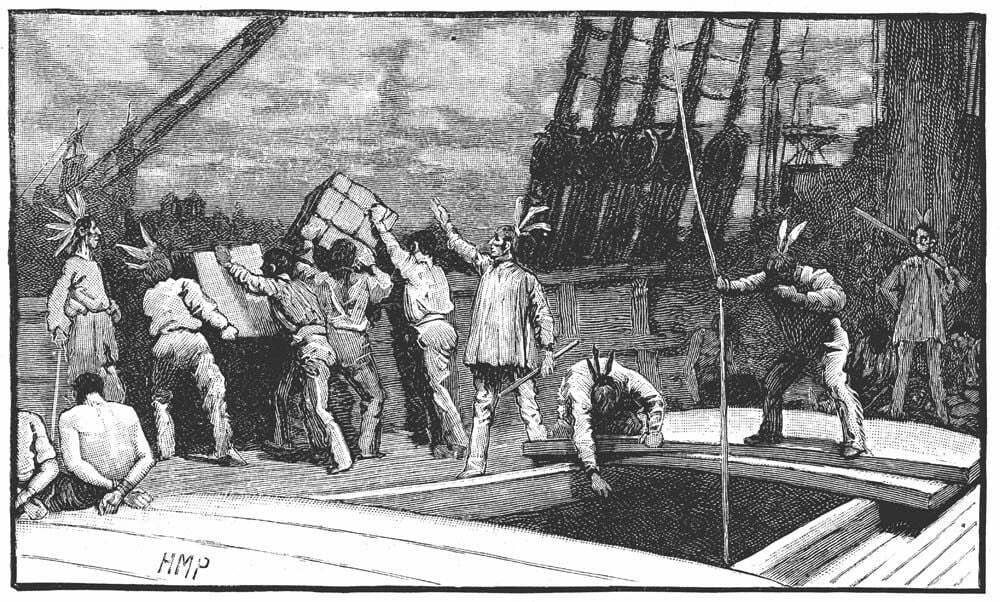 Boston Tea PartyEast India Company. It was a political protest against the Tea Tax that Parliament levied upon the Colonists and the perceived notion that the East India Company had a monopoly on the tea trade. The Colonists were also angry about not being represented in Parliament, so it was also a protest against “Taxation without Representation”. This was one of the first acts of defiance by the Colonists and started them on the road to Independence.
Paul Revere notified the New York Sons of Liberty of the Boston Tea Party on December 20th. A ship called The Nancy, carrying 698 chests of tea, double  New York Tea Partythe amount that was destroyed in Boston, was heading to New York Harbor. The Sons of Liberty sent a letter to the captain of the ship warning him, “of the determined Revolution of the Citizens not to suffer the Tea on board of his Ship to be landed.” The governor of New York, William Tryon, assured the Earl of Dartmouth that the tea could be safely stored and protected, even if they needed to use deadly force, such as cannons and bayonets. Fortunately, the tea was never unloaded. Governor Tryon came to an agreement with the Sons of Liberty, and the ship was sent back, with the Sons of Liberty paying for its provisions for the return trip. Eighteen chests of tea were discovered on another ship named The London. Those were thrown overboard and destroyed.
The Intolerable/Coercive Acts
After the Boston Tea Party, Parliament responded quickly. In 1774, Parliament passed the Coercive Acts, also known as the Intolerable Acts. These consisted of four acts:
- The Boston Port Act, March 25, 1774 – This banned the loading and unloading of any ships in Boston Harbor.
- The Massachusetts Government Act, May 20, 1774 – This act restructured the Massachusetts government by abolishing its charter that was in place since 1691. By doing so, Massachusetts became a Crown Colony, giving all power to an appointed official, the Royal Military Governor, Thomas Gage, who was now under the Crown’s control.
- Administration of Justice Act, May 20, 1774 – This act gave the Governor the right to move a trial to another Colony or Great Britain. This took away the right to a fair trial by your peers, a right guaranteed by the Magna Carta.
- The Quartering Act, June 2, 1774 - This was the only Act to apply to all of the Colonies. Soldiers needed to be billeted close to the areas in which they operated. Soldiers were to be housed in “uninhabited houses, out-houses, barns, or other buildings,” yet they were to be quartered at the colonists’ expense.
 Distress of the ColoniesAlthough the Coercive Acts were meant to punish Massachusetts and send a warning to the other colonies, they had the opposite effect. The other colonies came to Massachusetts's defense. This was the first time that all of the colonies were unified. Unlike the previous acts, the Stamp and Townshend Acts, the Coercive Acts weren’t repealed. These policies were the spark that ignited public opinion against Great Britain and set the colonists on the road to revolution.
In September of 1774, the first Continental Congress, as it has come to be known, was formed to discuss common grievances. The delegates met in Carpenter’s Hall in Philadelphia. The delegates didn’t want to renounce Parliament, and The First Continental Congress Independence wasn’t even talked about. They discussed the Coercive Acts and found them tyrannical. The Congress adopted the Articles of Association on October 20th and set a deadline for the Coercive Acts to be repealed by December 1, 1774. If they weren’t repealed, there would be an embargo of exports to Great Britain. On October 26, grievances were drafted in the form of a formal petition to King George III.

Next Month: Part 3- Lexington and Concord, and the Overthrow of New York's Colonial Government
Resources
Coercive Acts -
https://www.mountvernon.org/library/digitalhistory/digital-encyclopedia/article/the-coercive-intolerable-acts-of-1774
Committees of Correspondence
https://www.mountvernon.org/library/digitalhistory/digital-encyclopedia/article/committees-of-correspondence
https://www.battlefields.org/learn/articles/committees-correspondence
Boston Tea Party
https://www.battlefields.org/learn/articles/boston-tea-party
https://www.bostonteapartyship.com/boston-tea-party-cause
New York Tea Party
https://www.newyorkalmanack.com/2025/12/new-york-tea-party-boston-revolt/
https://www.frauncestavernmuseum.org/the-new-york-tea-party
Virginia Resolves
https://www.encyclopedia.com/history/dictionaries-thesauruses-pictures-and-press-releases/virginia-resolves#:~:text=Resolutions%20passed%20by%20the%20Virginia,era%20that%20lasted%20through%201824.
Illustrations
Quartering Act https://share.google/UouhussJyaemCT99T
New York protesting the Stamp Act -https://share.google/GDBL863GF5rK63r4i
Townsend Acts - https://share.google/NRWSYXSNFGrhqisiD
Tea Tax - https://www.britannica.com/event/Boston-Tea-Party
Boston Tea Party - https://share.google/fEdOAFjinU51BCzPW
Paul Revere - https://share.google/XwkksSYeGINSPi17k
Engine of Revolution - https://share.google/ddTWgtaEHJtEPaQyM
John Lamb - https://www.frauncestavernmuseum.org/the-new-york-tea-party
Announcement of the Arrival of the Nancy - https://www.frauncestavernmuseum.org/the-new-york-tea-party
New York Tea Party - https://share.google/cFbD8YzefmsoMbCZq
Committees of Correspondence - https://share.google/VW4oUbNm85O4FaqPA
Coercive Acts - https://alphahistory.com/americanrevolution/coercive-acts/
The First Continental Congress - https://share.google/Azb5a3jBLxtWyLbXQ